Showing posts with label Birds of a Feather. Show all posts

Sunday, October 23, 2011

Connections: Birds and Crabs, Part X

More than a million shorebirds stop over to gorge themselves on horseshoe crab eggs before continuing their northward migration.  During their stopover, the six most abundant shorebird species will consume approximately 539 metric tons (that’s 1,188,279.4 pounds)« of horseshoe crab eggs.  While this may seem like an awfully large number to you and me, it’s simply because of the low metabolic efficiencies of the birds.  As the birds eat the eggs and as the eggs are passing through the birds’ gastrointestinal tracts the cuticles of those eggs are often resistant to both chemical and enzymatic digestion.  As a result, very few of the eggs are broken down and available as nutrition for the hungry birds.  But, birds being birds (does the term “birdbrain” come to mind?) they continue to stuff their bellies with as many possible eggs as they can cram into their gullets – irrespective of any potential nutritional value (Life in a fraternity house is what I’m imaging now – how about you?).
            There have been some scientific calculations which estimate that at least 1.8 million female horseshoe crabs must spawn on the shores of Delaware Bay to provide this food surplus.  For example, nearly 50% of the world’s red knot population stops each spring in the Delaware Bay area.  When they arrive they are literally down to bone, skin and feather, having used up all their fat reserves and much of their muscle in flight.  They need the eggs to survive. 
            Numerous surveys have shown significant declines in the numbers of shorebirds.  The sanderling population alone has decreased an alarming 80 percent over the course of the last several decades.  Suspected causes for the decline are the use of pesticides in the winter grounds, loss of coastal wetlands along migration routes, competition with humans over prime coastline areas, and a possible decrease in available food sources.
            Biologists and birders are constantly tracking shorebird movements and population trends.  This information may help clarify a multitude of factors affecting bird populations.  Obviously, it will only be the fat, healthy birds who survive the long distance migration to arctic feeding grounds.  The short arctic summers mean time to raise only one small brood.  Consequently, low reproductive rates make it harder for any species of shorebirds to sustain healthy populations.
            The relationship between shorebirds and horseshoe crabs is both necessary and critical.«  We know the two are intimately related; however, current evidence suggests that shorebird feeding has no impact on the horseshoe crab population.  It remains to be seen what environmental factors are currently impacting the birds and whether the birds will be able to survive conditions over which they have no control; but rather which control them.


« In case you were wondering, 1,188,279.4 pounds (of horseshoe crab eggs) is equivalent to the weight of 2,495,346 Big Macs from McDonald’s, 4,659,917 orders of medium french fries from Burger King, or 3,046,869 small Frosty’s from Wendy’s.  Yum!
« On average, it has been estimated that migratory shorebirds will consume approximately seven billion (that’s 7,000,000,000) horseshoe crabs eggs in a two-week period.

Tuesday, October 11, 2011

Connections: Birds and Crabs, Part IX

Another small shorebird - ranging in length from five to seven inches – is the Semi-palmated Sandpiper (Palmation refers to the webbing between an animal’s toes.  Thus, a semi-palmated bird is one that has very short webbing between its toes.  Again, you would have to be really really close to this bird [eye to toes] to notice this particular feature).  The adults have moderately long black legs and a moderately long bill that may droop slightly at the tip.  Their body is gray-brown on top and white underneath with a streaked breast.  One of their most distinctive habits is their ability to sleep on one leg with their bill tucked into their back (Unless you are into some serious yoga, this is not something I would recommend you try – no, not even in the privacy of your own bedroom).
            The Semi-palmated Sandpiper’s non-breeding winter range extends along the coastline of the northern edges of South America – from the southern tip of Peru all the way around to southern Brazil.  On the other hand, their summer breeding range traces a primarily aquatic territory from northwestern Alaska, across northern Canada, and up into the Arctic Circle.
            Like many migratory birds, Semi-palmated Sandpipers nest on the ground.  The male makes several shallow scrapes on the ground.  During this process, the female patiently waits and then carefully selects one of the scrapes (in much the same manner, and in approximately the same amount of time, as one’s daughter might select a wedding dress) – adding grass and other plant material to line the nest.  The female will lay about four eggs in the nest and afterwards, the male assists with the incubation process.  Again, the females, like Ruddy Turnstone females, leave the young with the male after just a few short days.  Soon thereafter, the young begin feeding for themselves.
            Semi-palmated Sandpipers migrate in flocks which can number in the hundreds of thousands.  Flocks of these birds, flying in formation, are quite a sight, particularly as they sweep over their favored feeding locations along the Delaware Bay.  For the most part, these birds will congregate on mudflats.  When not dining on horseshoe crabs eggs, they will often forage on aquatic insects and small crustaceans.

Monday, October 3, 2011

Connections: Birds and Crabs, Part VIII

            Another predominant shorebird to visit the shores of Delaware Bay is the small (7-8 inches in length), plump Sanderling.  In summer its back, head and neck is a bright rusty-red with splatterings of black.  It also sports a white belly, black legs and bill.  In flight they show a strong white wingbar.  The winter bird, on the other hand, is very pale, almost white apart from a dark shoulder patch.  This is the source of its species name, alba, which is the Latin for "white."  Sanderlings are distinguished from other wading birds by the absence of a hind toe (Note to potential birders: You have to be really, really close to a Sanderling to see that it doesn’t have this appendage.).  This species includes some of the smallest of all shorebirds, with a weight range of 1.4 to 3.5 ounces.«
            Like Red Knots, Sanderlings are circumpolar breeders wintering primarily in the southern regions of South America, Africa and Australia.  Known as a highly gregarious bird, it will often form enormous flocks on sandy beaches or coastal mudflats.  Its diet consists mainly of small crabs and other tiny invertebrates.  They are also distinguished by a unique “bicycling” motion as they scamper across the beach, stopping frequently to pick up small food items.  A flock of these birds scampering across the beach looks very much like the peloton in the Tour de France as it winds its way around deep valleys and across rich vineyards throughout the three-week race.
            After departing the feast on the Delaware Bay, these birds head for the breeding grounds of the high Arctic region.  There, the female will lay a clutch of three to four eggs in a ground scrape.  Their diet changes considerably while in these polar regions – everything from insects to various kinds of plant material.


« A sanderling weighing 50 grams (1.7 ounces, or the weight of ten nickels) can eat one horseshoe egg every five seconds for 14 hours a day (that’s 10,080 eggs a day).

Wednesday, September 28, 2011

Connections: Birds and Crabs, Part VII

            Another predominant shorebird that visits the Delaware Bay is the ruddy turnstone.  This traveler is a short-legged bird about eight to ten inches in length.  It has a short, dark bill that is slightly upturned at the end and a harlequin pattern of black, white and rust-red in alternating patterns on its top along with a black patch on its chest (Go downtown and you’ll probably see a similar pattern on certain “ladies” standing on the street corner.).  Its belly is white and its short legs are coral-red.  In summer, its uppersides are a combination of white, rusty-red and black.  To many people (at least to this observer), the ruddy turnstone often looks like it has been playing in an artist’s palette - carrying away a panache of colors here and there on its body.
            The ruddy turnstone winters on three coasts from California to New Jersey to Argentina.  It breeds primarily along coastal tundras from western Alaska east to Greenland and can also be found in selected arctic regions of Europe and Asia.  In winter, it spends considerable time in a host of near-water habitats including mudflats, sandbars, sandy or muddy shores, beaches and rocky coasts.  It is a good swimmer and may spend hours bathing and preening in shallow water areas.
            When it searches for food, the ruddy turnstone has the unique ability of flipping over rocks as it looks for small animals, typically invertebrates.  This unique rock-flipping action gives it its name (Some folks call it the “seaweed bird” because it often feeds among the kelp at low tide.).  In addition, they have the ability to dig into the sand in pursuit of tiny crustaceans.  Its diet is diverse and eclectic – dining primarily on small mollusks, crustaceans, grasshoppers, insects, larvae, maggots, worms, and, of course, the eggs of horseshoe crabs.
            Males and females will pair off either before or after reaching their breeding ground.  They tend to build their nests in open grassy areas near the water.  After the female lays approximately four eggs in a grassy area both parents will trade off incubating the eggs.  Just like urban street gangs or a slightly inebriated construction worker guarding a certain barstool at the local bar, the male turnstones are extremely territorial.  They will often patrol the border of the nesting site and will aggressively chase away any potential intruders. About 22-24 days after the eggs are laid, the chicks will hatch – with both parents caring for the young.  However, the female will leave before the chicks are fully fledged (sounds like a recurring soap opera theme) while the male remains. 

Monday, September 19, 2011

Connections: Birds and Crabs, Part VI

Each long-distance journey poses significant physiological challenges for the red knot.  As a result, their bodies must make several adaptations in order to survive the trip (similar, I suppose, to the physical adaptations we all have to make when trying to cram ourselves into a much-too-narrow airplane seat for a cross-country flight).  Immediately prior to each journey, the birds’ flight muscle mass increases while their leg muscle mass decreases.  Their stomach and gizzard masses decrease, while fat mass increases by more than 50 percent.  Throughout their wintering range they feed primarily on small mussels and other mollusks, shell and all.  However, when traveling long distances they eschew those hard foods because of their shrunken gizzards.  It is primarily the soft eggs of the horseshoe crab they are able to ingest.  Since the red knot’s spring migration is synchronized with the release of horseshoe crab eggs, those eggs become the ideal food for a long-distance traveler.  As a result of the super-abundance of the eggs across Delaware Bay beaches, the birds save considerable energy in hunting for necessary food sources.

            When red knots arrive at the Delaware Bay they are exceedingly thin, almost to the point of emaciation.  As a result, they need to eat constantly in order to increase their fat mass sufficient to continue their journey.  It is not unusual for them to gain up to 10 percent of their body weight each day and double their body weight during their time along the Bay.  There is at least one estimate that each red knot must eat approximately 135,000 horseshoe crabs eggs (in a period of about two weeks) in order to double its overall weight.

Thursday, September 8, 2011

Connections: Birds and Crabs, Part V

Although upwards of 30 different species of birds may crowd the beaches of Delaware Bay, there are four primary shorebirds that use the Bay as a stopover area during their northward migration.  Red Knots, Semi-palmated Sandpipers, Ruddy Turnstones, and Sanderlings make up approximately 97 percent of the birds that visit these shores.  Let’s take a look at each of these distinctive species.
            Red knots have an average wingspan of about twenty inches (this is slightly more than the distance from the tip of your middle finger to your elbow) and an overall length of approximately nine inches (a distance slightly longer than that from the tip of your middle finger to your wrist).  Their backs look like a psychedelic checkerboard – a crazy assembly of mottled buff, streaks of black, and bits of white in a seemingly haphazard pattern.  Their distinctive name comes partly from the fact that much of their head and all of their belly is robin-red.
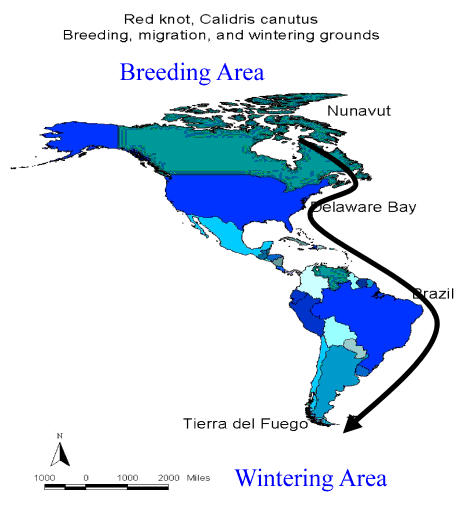
            Red knots winter along the southern coasts of South America, primarily in Tierra del Fuego (Spanish for “land of fire,” and discovered by Ferdinand Magellan in 1520).  During its breeding season the Red Knot inhabits the mainland and islands scattered across the Arctic Circle.  Take a look at a globe and you will quickly appreciate the incredible distances it has to fly each year - 9,300 miles from south to north every spring and 9,300 miles from north to south every autumn (that’s an annual journey of 18,600 miles – a distance equivalent to three-and-a-half round trips, by car, between Los Angeles and Washington, DC).  As you might imagine, this bird is regarded as one of the longest-distance migrants in the animal kingdom.«
            Red knots migrate in enormous flocks – gatherings that are considerably larger than most other shorebirds.  Most migrating birds tend to cover enormous distances in one fell swoop (pardon the pun); however, red knots tend to segment their journeys into sections of about 1,500 miles at a time.  As a result, they tend to having “staging areas” – specific landing spots along the entire Atlantic coast.  They will use the spots regularly (just like you might travel to the same vacation destination year after year) – stopping in the same places at approximately the same times year after year.  These favorite stopping off points are familiar territory for the red knots and they can anticipate the available of food at each location.  On the downside, however, these sites make the bird susceptible to poaching, severe habitat change, and endemic diseases and toxins.  As an example, red knots were heavily hunted in the early 20th century, and have never fully recovered in parts of eastern Canada. 


« A red knot banded in May 1987 was identified again on Delaware Bay in May 2000. During the intervening thirteen years, it was estimated that this single bird flew approximately 242,350 miles, a distance greater than that between the earth and the moon (the average distance between these two celestial objects is 238,855 miles).

Sunday, September 4, 2011

Connections: Birds and Crabs, Part IV

As you might imagine, eggs that lay buried in the sand have the greatest likelihood for survival.  Eggs driven closer to the surface have the least likelihood for survival due to any number of environmental factors (lack of moisture, lack of adherence), but also because they become more readily available for shorebird consumption.  There’s also another factor at play here – the length of the shorebirds’ bills.  For example, red knots (whom you will meet shortly), one of the most prevalent of the migrating shorebirds, have some of the longest bird bills – on average 1.3 inches long.  Thus, they can forage in moist sand and extract any eggs within 1.3 inches of the surface.  Obviously, eggs buried deeper are beyond their reach and thus considerably safer and considerably more viable.
            You might think that the length of the red knot’s bill would deny it access to any of the deep-buried eggs.  Not so.  For, if nothing else, the red knot are opportunistic feeders – in short, they allow others to do all their work for them.  In this case the workers are the other horseshoe crabs who dig and scrape and mess around the nests of previous females – disturbing and excavating previously-laid eggs as they try to lay their own eggs.  Being the first to lay one’s eggs isn’t always a good thing – it may subject those eggs to the “digs” of females who follow.  Archeologists sometimes experience something similar  when they discover an ancient city that has been built on the ruins of a previous ancient city which has been built on the ruins of yet another ancient city.  A succession of spawning females – all nesting at approximately the same spot on the beach – has the potential to release thousands and thousands of eggs from each of the previous nests and onto the beach.  The more eggs released, the more eggs available for consumption – even by birds with short bills.

Monday, August 29, 2011

Connections: Birds and Crabs, Part III

          It may be surprising to learn (as it was for me) that the relationship of horseshoe crabs with the spring migration of migrating shorebirds has only received extended scientific attention since the early 1980s.  It was then that the New Jersey Audubon Society’s initiated shorebird surveys of Delaware Bay beaches.
            The shorebirds are lured here by an incredible banquet of little green eggs.  Approximately thirty different species of shorebirds bent on doubling their body weights cram the Delaware and New Jersey shorelines.  According to Mark Botton, a professor of biology at Fordham University and one of the leading experts on the American horseshoe crab, these “staging areas serve as [vital] stopover points for the birds to feed before continuing their migration.  An estimated 425,000 to 1,000,000 birds stop in Delaware Bay…during May and June, as they travel from their South American wintering grounds to their Arctic breeding grounds.” 
            Most of the activity tends to occur during the third or fourth week in May.  Hundreds of thousands of migrating shorebirds arrive just as hundreds of thousands of horseshoe crabs emerge from the depths of Delaware Bay to lay their eggs.  Intensive studies have revealed that each female crab will deposit up to twenty egg clusters during her spawning period.  Each of those clusters will contain between 3,000 and 4,000 eggs.  Thus, each female has the capacity for laying up to 80,000 eggs during a single spawning season.«  Multiply that 80,000 by up to a million or more crabs and you can quickly see that the banquet offering for birds has the potential to exceed their wildest dreams (if, indeed, birds could dream).
            Most female crabs will deposit their eggs approximately 4-6 inches below the surface of the sand.  Although this depth is beyond the reach of most shorebirds, constant wave action and the burrowing of other spawning crabs (female crabs will deposit their eggs wherever they want – irrespective of whether another female has deposited her eggs in a particular location or not.  In short, every square inch of the beach is “fair game” as a potential egg deposit area.) move some of the eggs toward the sand’s surface.  It is these “disturbed” eggs that the voracious shorebirds seek.


« For those who wish to compare horseshoe crabs with humans, here are some relevant facts:  A human female typically has about 400,000 potential eggs, all formed before birth.  Only about 480 of those eggs will actually be released during her reproductive years.  And, in case you were about to ask - your average chicken will lay about 300 eggs in her lifetime.

Saturday, August 20, 2011

Connections: Birds and Crabs, Part II

           These shorebirds are travelers with a purpose – like a family on a cross country summer drive.  Except that the winged travelers in this geographical location have come all the way from the southern tips of South America and will eventually travel all the way to distant and necessary nesting grounds near the Arctic Circle.  This is an annual ritual - a long and exhausting journey each spring that provides these birds a few precious stops along the way…a few precious places to feed and rest.  Delaware Bay just happens to be one of those stops and the timing of their visit is critical.  It is vital that the birds reach the Arctic while the snow is melting to ensure their eggs will hatch in time for the annual insect hatch.  Those insects constitute the primary diet of the young shorebirds.  If the birds arrive too early the insects are not there.  If they arrive too late the newly hatched young have nothing to eat.  This is similar, in many respects, to the feeding habits of teenage boys (“There’s nothing in the refrigerator!,” he yells.  “Sure there is, I just went shopping,” his mother yells back.  “There’s nothing GOOD in the refrigerator!,” he yells even louder.).
            The Delaware Bay is a critical stopover point in the long-distance journey to Arctic regions.  It is vitally important that the hungry birds find plenty of food here or they will not have sufficient energy to complete their arduous journey.  Most have traveled night and day and day and night to arrive here.  After departing from near the bottom of the world they make a single pit stop on the southeast coast of Brazil.  After a brief rest they take off for an unbelievable nonstop journey of 5,000 miles over vast oceanic distances and occasional land forms for the shores of Delaware Bay.  Imagine traveling for 5,000 miles hoping, just hoping, that there will be some food at your destination.  If there is, you live!  If not,….
            The Delaware Bay is not haphazard – for it is here that one of the great massings of creatures takes place each year.  It is here that one of the great mysteries of nature is about to unfold – the arrival of these birds in concert with the arrival of horseshoe crabs upon these beaches.  Consider, if you will, the incredible biological coincidences of these two species arriving almost at the same place at almost the same time – all within a very narrow window of opportunity.  It is though a great script has been written and the players (birds and crabs) are merely fulfilling their ecological obligations – obligations that have been taking place for thousands of years.

Sunday, August 14, 2011

Connections: Birds and Crabs, Part I

          It is early morning as I walk out on a very deserted beach along the western edge of Delaware Bay.  The sun is just edging through last night’s cloud cover and it sprinkles the sand with a few errant rays of sunshine.  As I gaze out over the beach I can see clusters…no, hoards…no, armies of birds swopping and swarming and dancing and flittering across the vast sandy stretch.
          I grew up a mere wing flap from San Juan Capistrano in southern California.  Each year, on St. Joseph’s Day (March 19) the swallows would return to San Juan and begin rebuilding their mud nests, each of which would cling to the ruins of the old stone church.  The arches (which are ideal for nest-building) of the two story, high vaulted Chapel were left bare and exposed, as the roof collapsed during the earthquake of 1812.  The town of San Juan Capistrano always takes on a festive air as scores of (human) visitors from all parts of the world gather to witness the "miracle" of the swallow’s return.
            What I am now witnessing on a stretch of Delaware beachfront reminds me of the hordes of migrating birds I saw in my youth.  Here, however, the birds are of every stripe, color, and description.  There is a constant blur of wings, a cacophony of shills, shrieks, and calls, and the “crissing” and crossing of flight paths as winged travelers dart through the pale blue sky and dance their way over the consistency of waves.  With shrill squeals and whistles, flock after flock and battalion after battalion of birds loop, glide, descend and fight.  They swoop and swirl and swarm over long lengths of sand – claiming territory for a few moments and giving it up just as easily with each new arrival.  The constant noise and never-ending activity makes the beach seem like an avian insane asylum.  This is craziness – bird craziness - to the tenth power!
            Crowded onto a far-reaching strip of land that bisects the waters of Delaware Bay and the lazy dunes of sand behind me is one of the largest gatherings of birds in the world.  These birds are on a quest – they are determined, they are pushy, but most of all they are hungry.  Their numbers are a million or more and they have been flying almost nonstop from their winter homes thousands of miles to the south.  From remote beaches in Patagonia, Tierra del Fuego, and the furtherest and most isolated reaches of South America a seemingly unending multitude of starving shorebirds have come to Delaware Bay.
            The gulls are bullies – they crowd together pushing and shoving against the great mass of their long-distance cousins.  Long-billed dowitchers poke and root beneath the wet sand at the water’s edge.  Yellowlegs wade in the shallows searching for food.  Red knots sweep across the sand like large flapping curtains randomly tossed over the landscape.  Sandpipers dance in and out of the gentle waves playing tag with each other.  Ruddy turnstones, sanderlings, plovers, dowitchers, dunlins, and willets all arrive – wave after unending wave after unending wave.  This does not have the gentility of San Juan Capistrano (tiny swallows are, oh, so much more polite) – the birds here are ON a mission, not IN a mission.
            They are here for the eggs…a feast of horseshoe crab eggs.